
We get asked to evaluate React Native for almost every mobile project that walks in the door. The answer used to be “it depends.” In 2026 the answer is still “it depends,” but the tradeoffs have shifted.
React Native has gotten dramatically better. The new architecture is finally stable, the Hermes engine handles JavaScript performance well, and the ecosystem has matured around a small set of mature libraries instead of the chaos of 2019. The cases where it loses to native are narrower. They still exist.
The questions we ask first
Before tooling, we ask about the team. Does the team have a React-fluent web frontend? If yes, RN multiplies their effective output. If the team is brand new to JS and you’re trying to hire two iOS engineers, RN doesn’t save you anything — you’re still hiring, just for a different stack.
We ask about the surface area. A reading-and-writing app (lists, forms, navigation, occasional media) is RN territory. An app that lives in the camera, in CoreML, or in audio processing is borderline. An app whose value proposition is the smoothness of a custom interaction (a drawing tool, a video editor, a game) is native, almost always.
We ask about the lifespan. RN apps that we’ve maintained for three years are still maintainable. RN apps we’ve inherited that haven’t been updated in a year are typically broken — the ecosystem moves, and falling behind compounds.
Where RN clearly wins
Apps with significant business logic that would otherwise be duplicated. Internal tools where iOS and Android need to ship in lockstep. Cross-platform apps for early-stage products where every week of velocity matters. Codebases where the team is full-stack JS and adding two native specialists would change the team dynamic for the worse.
Where native clearly wins
Apps where 60fps performance under heavy interaction is the product. Apps that need deep platform integration on iOS (Live Activities, app intents, Vision Pro support). Apps targeting industries where a senior native engineer is already on the team and the marginal cost of native is low.
Games are not RN territory. We’ve never recommended otherwise.
The hiring math
The market for senior React Native engineers in Israel and Eastern Europe is healthier than it was three years ago. The pool isn’t as deep as for native iOS or Android, but it’s not the bottleneck it once was. We’ve successfully hired RN engineers from React web backgrounds with three months of ramp-up. We’ve also seen companies fail at this — the ones that did underestimated the platform-specific work that doesn’t go away just because you chose RN.
A realistic RN team for a real product needs at least one engineer with deep iOS or Android experience, even if they’re not writing native code daily. They handle the rough edges: build configurations, store submissions, deep links, push notifications, the inevitable native module that wasn’t written in JS. Pretend otherwise at your peril.
What we ship
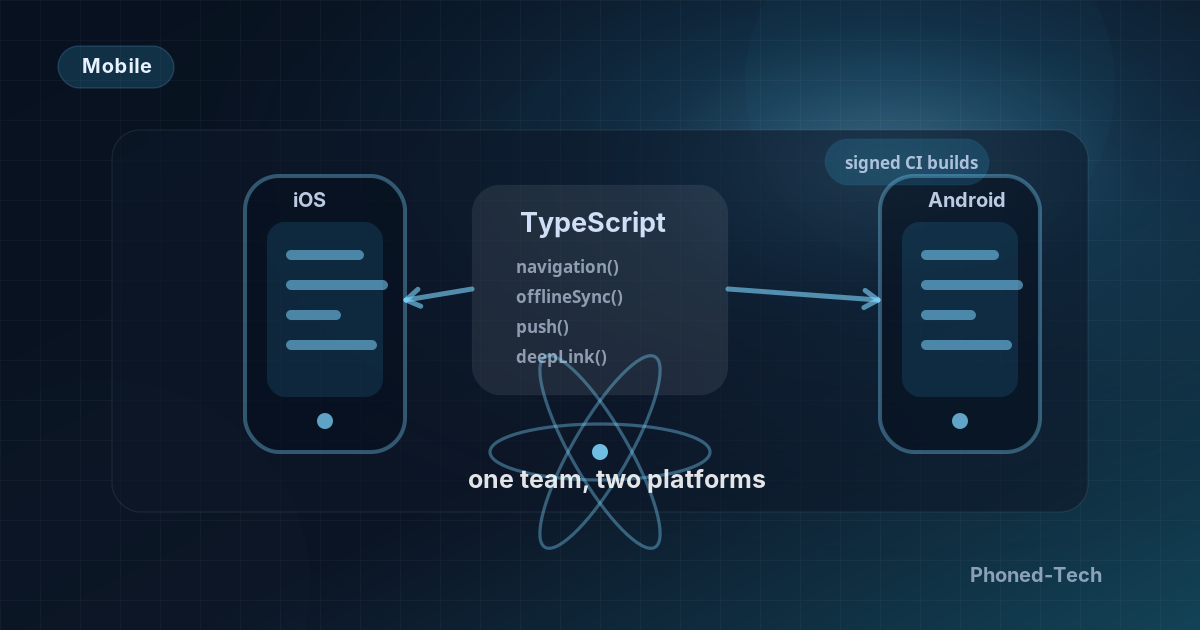
Every RN project we deliver includes: TypeScript everywhere, a tested navigation setup, an offline-first data layer, push notifications, deep links, store-ready builds for both platforms, crash reporting, and a CI pipeline that produces signed builds on every PR. That’s the minimum viable mobile app. RN gets you there with one team instead of two.